


On this page
Security and Isolation
Dedicated servers offer physical resource isolation, which improves security compared to shared environments. However, additional protective measures are still essential.
Look for providers offering:
-
Advanced firewall configurations
-
DDoS mitigation systems
-
Secure remote access controls
These safeguards are especially important for businesses managing customer data, payment systems, or proprietary applications.
Selecting an affordable dedicated server USA solution should never mean compromising on essential security standards.
Scalability and Upgrade Options
As businesses grow, infrastructure requirements evolve. A well-designed hosting environment should allow easy upgrades to RAM, storage, or CPU capacity without disrupting operations.
USA data centers are designed to support scalable infrastructure, enabling companies to expand resources without migrating to a different region or provider.
This flexibility is particularly valuable for startups, SaaS companies, and digital agencies managing multiple projects.
Global Performance Comparison of Dedicated Server Regions
| Region | Latency | Reliability | Global Connectivity | Support Quality |
|---|---|---|---|---|
| USA | Low | High | Excellent | 24/7 |
| Europe | Medium | High | Very Good | 24/7 |
| Asia | Low (Regional) | High | Good | 24/7 |
| Global Distributed | Optimized | Very High | Excellent | 24/7 |
This comparison highlights why USA-based dedicated servers are often chosen as a primary hosting location while still serving international audiences efficiently.
Speed, Uptime, and Security Advantages of USA Dedicated Servers
Speed
USA servers benefit from premium network routing and proximity to major internet backbones, enabling faster data delivery and stable bandwidth performance for demanding applications.
Uptime
Leading US data centers maintain redundant power systems, advanced cooling infrastructure, and multiple carrier connections, significantly reducing downtime risk.
Security
Physical server isolation combined with network-level protection systems and enterprise security policies makes USA dedicated servers an excellent option for organizations prioritizing data protection.
Conclusion
Choosing the best dedicated server in USA involves more than simply comparing prices. Key factors such as performance, uptime reliability, security, and scalability should guide the decision. A well-chosen dedicated server becomes the foundation for long-term business growth, improved user experience, and operational stability.
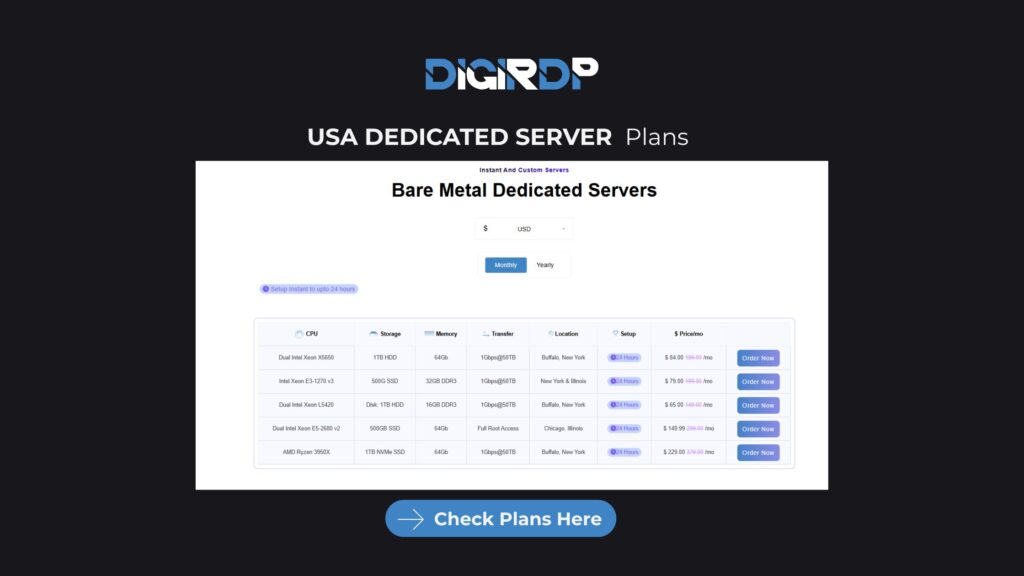
DigiRDP provides USA dedicated server solutions built for modern businesses that value control, reliability, and scalable infrastructure. Whether you are expanding an existing platform or launching a new digital service, the right dedicated server can significantly improve performance and long-term operational success.
Ready to deploy your own server?
Full admin access, DDoS protection and instant setup — pick a plan sized to your workload.
Explore Dedicated Servers