




On this page
If you need ultra-fast connectivity in Asia, stable uptime, and enterprise-grade hardware, buying a high speed Singapore VPS is no longer optional—it’s mandatory. As a server admin working with latency-sensitive workloads, I’ve seen how Singapore’s network backbone consistently outperforms other APAC regions for gaming, forex trading, surveys, and admin automation.In this 2026-ready guide, I’ll break down how to Buy high speed Singapore VPS, what hardware actually matters, and why DigiRDP is built differently from generic Singapore VPS providers.
Buy high speed Singapore VPS means renting a virtual private server hosted in Singapore with NVMe storage, low-latency routing, and 1Gbps–10Gbps ports, optimized for Asia-Pacific traffic. In 2026, the best Singapore VPS uses KVM virtualization, AMD EPYC CPUs, and Tier-3 data centers for maximum speed and stability.
Why Singapore VPS Is the APAC Standard in 2026
Singapore is not just another hosting location. It’s the network hub of Asia-Pacific, connecting India, Southeast Asia, Australia, and East Asia with minimal hops.
Most users searching for cloud vps Singapor or vps hosting in Singapore are facing one of these problems:
- High ping from India or Southeast Asia
- Unstable VPS providers overselling CPU
- Slow I/O due to SATA or outdated NVMe
- No admin/root access
- Poor support when something breaks
At DigiRDP, we designed our Singapore VPS stack specifically for high-speed workloads—not cheap shared nodes.
What Does “Buy High Speed Singapore VPS” Actually Mean?
When admins say “high speed,” they’re not talking about marketing claims. They mean:
- Latency under 40ms to India & SEA
- Dedicated CPU cores (no noisy neighbors)
- NVMe 4.0 storage with high IOPS
- 1Gbps or 10Gbps port speed
- KVM virtualization (not OpenVZ)
Anything less is not a real high-speed VPS in 2026.
Why Singapore Is the Best VPS Location in Asia
1. Network Backbone Advantage
Singapore peers directly with major submarine cables. This reduces packet loss and jitter for:
- Forex brokers
- MMO game servers
- Survey automation tools
- Cloud scraping tasks
2. Regulatory Stability
Unlike some APAC regions, Singapore offers:
- Strong data center compliance
- Predictable uptime
- No sudden IP blacklisting
3. Ideal for Global Routing
If you also operate USA or residential workloads, pairing Singapore VPS with a US residential machine (see DigiRDP’s real residential option) creates a balanced global setup.
DigiRDP Singapore VPS – Hardware & Virtualization (2026 Specs)
CPU Architecture
- AMD EPYC 7003 Series
- High core density
- Consistent clock speeds under load
For high-power compute tasks (rendering, gaming emulation), DigiRDP also offers Ryzen-based machines such as the India Ryzen 7950X RDP for extreme workloads.
Storage
- NVMe 4.0 SSD
- 6x faster than SATA SSD
- Ideal for MT4/MT5 logs, databases, and automation scripts
Virtualization
- KVM Hypervisor
- Full kernel isolation
- Custom ISO support
- Better security than container-based VPS
Network
- 1Gbps standard
- 10Gbps available on premium plans
- Optimized Asia routing tables
Cloud VPS Singapore vs Traditional VPS Hosting in Singapore
Many users confuse cloud vps Singapor with basic VPS hosting. They are not the same.
| Feature | DigiRDP Cloud VPS Singapore | Generic Singapore VPS |
|---|---|---|
| CPU | AMD EPYC Dedicated Cores | Shared Xeon |
| Storage | NVMe 4.0 | SATA / NVMe (shared) |
| Virtualization | KVM | OpenVZ |
| Port Speed | 1–10Gbps | 100–300Mbps |
| Root/Admin | Full Access | Limited |
| Support | Real Admins | Ticket Bots |
Who Should Buy High Speed Singapore VPS?
🎮 Gamers
- Lower ping to SEA servers
- Stable FPS for cloud gaming
- No packet loss during peak hours
For GPU or encoding workloads, DigiRDP also offers streaming-optimized RDP solutions built for video processing.
📈 Forex Traders (MT4/MT5)
- Ultra-low latency to Asian brokers
- 24/7 uptime
- No slippage from lag
Singapore VPS consistently delivers sub-50ms latency to brokers in Tokyo, Hong Kong, and Sydney.
📝 Survey Workers
- Clean Singapore IPs
- Fast page load
- Reduced captcha triggers
🧑💻 Admins & Developers
- Full root access
- Custom firewall rules
- Docker & Kubernetes ready
If you need unrestricted control, DigiRDP’s admin-level RDP environments integrate seamlessly with Singapore VPS deployments.
How to Buy High Speed Singapore VPS from DigiRDP
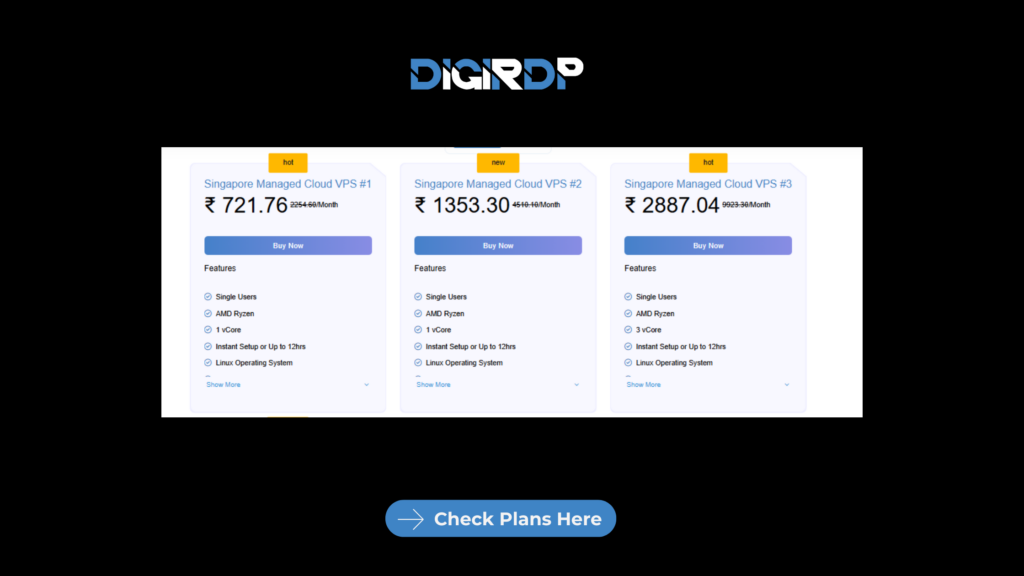
- Choose your Singapore VPS plan
- Select OS (Windows or Linux)
- Get instant credentials
- Deploy within minutes
No manual verification delays.
Why DigiRDP Is a Trusted Singapore VPS Provider
Most Singapore VPS providers oversell. DigiRDP does not.
What We Do Differently
- CPU core limits enforced
- Disk I/O caps removed
- No fake “unlimited bandwidth”
- Real human support
Even our budget users often start with cheap VPS or RDP plans and later upgrade to Singapore high-speed nodes once workloads scale.
Latency Benchmarks (Real-World)
| Location | Avg Ping |
|---|---|
| India | 35–45ms |
| Indonesia | 15–20ms |
| Malaysia | 8–12ms |
| Australia | 90–110ms |
These numbers matter for automation, trading, and gaming stability.
Security & Compliance (2026 Standards)
- DDoS-protected uplinks
- Isolated KVM instances
- Custom firewall rules
- Optional private networking
Singapore’s data center ecosystem ensures uptime even during regional outages.
Final Thoughts
If your workload depends on speed, stability, and Asia-Pacific reach, buying a high speed Singapore VPS is the smartest infrastructure decision you can make in 2026. DigiRDP’s Singapore VPS is built for real performance, not marketing promises.
Ready to deploy your own server?
Full admin access, DDoS protection and instant setup — pick a plan sized to your workload.
Explore Cloud VPS plans