



On this page
If you are attempting to access Indian platforms while using a non-Indian server, you are already operating at a disadvantage. Modern websites, trading systems, survey portals, and advertising networks have evolved far beyond simple location checks. Today, they evaluate IP reputation scores, ASN ownership, latency patterns, behavioral consistency, and device stability. Because of this, professionals increasingly choose to purchase Indian RDP solutions instead of relying on VPNs, shared proxies, or offshore VPS setups.
DigiRDP deploys Indian RDP servers inside data centers located within India, powered by modern AMD Ryzen and EPYC processors, ultra-fast NVMe 4.0 storage, and clean Indian IP ranges.
What It Means to Buy Indian RDP
Purchasing Indian RDP means renting a remote Windows desktop hosted on a server physically located in India and assigned an Indian IP address. This setup provides low latency, higher trust alignment with Indian platforms, and consistent access to region-restricted services.
Indian RDP has become essential for tasks such as survey participation, Forex trading, automation, administrative work, and account management. The physical location of the server and the ownership of the IP address now directly impact whether platforms allow or restrict your activity.
Why Location Now Determines Access
In the past, server location mostly affected speed. Today, it determines accessibility and trust.
Indian platforms commonly analyze:
-
IP geolocation and ASN ownership
-
Whether the IP is residential or data center classified
-
Latency stability and routing patterns
-
Session behavior consistency
-
Operating system and device reliability
Using a foreign VPS or VPN often leads to immediate issues such as survey disqualifications, repeated verification requests, delayed trade execution, or security challenges on social platforms. An authentic Indian RDP aligns geographic identity, network signals, and performance metrics with platform expectations.
What a Genuine Indian RDP Should Include
Not every provider promoting “Indian RDP” actually delivers genuine Indian infrastructure. The label alone means nothing unless the underlying network and hardware truly operate within India.
A legitimate Indian RDP must meet strict technical standards:
-
Servers physically hosted inside Indian data centers — not offshore machines masked with tunneled routing.
-
IP blocks registered under Indian ASNs — ensuring proper ownership, regional authenticity, and stronger trust alignment.
-
Low-latency domestic routing — consistent in-country network paths that avoid suspicious cross-border traffic patterns.
-
Modern, enterprise-grade hardware — capable of handling 24/7 workloads without resource instability or bottlenecks.
Many low-cost sellers cut corners by hosting servers in Singapore or Europe while assigning Indian IPs through GRE tunnels or proxy routing. While this may appear legitimate at first glance, advanced geo-detection systems analyze routing paths, latency signatures, and ASN mismatches. These setups frequently trigger verification checks, survey disqualifications, reduced trust scores, or unstable platform access.
True Indian deployment means the server, network, and IP reputation all align geographically and technically. That alignment directly affects latency stability, behavioral consistency, and long-term account reliability.
DigiRDP operates with authentic India-based infrastructure—real domestic data centers, clean Indian IP ranges, optimized routing, and modern Ryzen/EPYC hardware. The focus is not on cosmetic labeling, but on delivering technically sound environments built for consistent performance and operational stability.
Indian Admin RDP vs Indian Residential RDP
Choosing the wrong RDP type is a common mistake. Each serves different purposes.
Indian Admin RDP – Full Control and Performance
An Indian admin RDP provides administrator-level access to the Windows environment. This means you have complete control over system configuration.
With admin access, you can:
-
Install trading platforms and custom software
-
Run automation tools and scripts
-
Configure firewall rules and ports
-
Optimize system services
-
Operate background processes continuously
Admin RDP environments are typically deployed using virtualization technologies like KVM or Hyper-V, ensuring dedicated CPU allocation, RAM isolation, and stable resource performance.
This option is ideal for Forex traders, system administrators, developers, and automation users who require full customization and persistent uptime.
Indian Residential RDP – IP Trust and Authenticity
Residential RDP solutions use IP addresses associated with real Indian internet service providers rather than traditional data center ranges.
Many platforms automatically flag:
-
Data center IP classifications
-
Frequently recycled IP blocks
-
Networks identified as VPN or proxy infrastructure
Residential IPs significantly reduce the likelihood of instant bans, CAPTCHA triggers, or repeated phone and email verification prompts. For survey workers, digital marketers, ad verification professionals, and account managers, IP authenticity can matter more than raw server power.
Why Latency Is Critical
Latency is no longer just about page loading speed; it influences trust scoring systems and behavioral analytics.
Typical routing differences:
-
Europe to India: high latency with unstable timing
-
Singapore to India: moderate latency
-
India to India: minimal latency with consistent routing
Lower latency improves page load timing patterns, session stability, behavioral consistency, and platform trust metrics. Indian-based servers operating on 1Gbps ports, with higher-capacity uplinks available on premium nodes, ensure smooth performance even under heavy workloads.
Hardware Standards You Should Expect
Outdated server hardware can create bottlenecks that directly impact productivity and reliability.
Processor Architecture
Modern high-performance deployments use:
-
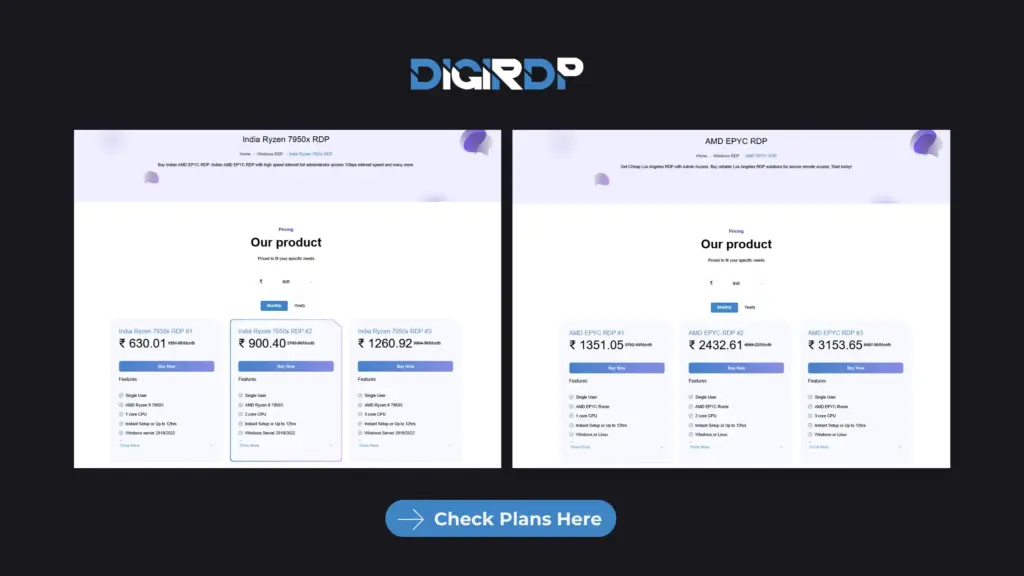
Indian Ryzen 9 7950X for high-frequency workloads
-
AMD EPYC 7003/7004 series for sustained multi-core tasks
These processors deliver superior performance compared to legacy Xeon systems still used by many low-cost providers. High-frequency CPUs are particularly valuable for browser-heavy tasks, automation scripts, and trading applications that rely on rapid execution.
Storage Performance
NVMe 4.0 SSD storage has become a baseline requirement for serious workloads. Compared to traditional SATA SSDs, NVMe offers dramatically lower latency and higher throughput.
Fast storage benefits:
-
Trading platforms with frequent read/write operations
-
Automation tools generating logs
-
Database-driven applications
-
Multi-tab browser environments
Shared disk bottlenecks can create inconsistent performance, which in turn affects platform trust and workflow stability.
Network Quality and IP Reputation
CPU and storage performance mean little without strong network quality.
A reliable Indian RDP should provide:
-
Clean, monitored Indian IP ranges
-
DDoS-protected uplinks
-
Optimized routing to major Indian ISPs
-
Stable packet delivery under load
IP reputation plays a major role in account longevity. Recycled or abused IP ranges often trigger restrictions regardless of server performance.
Real-World Applications
Survey Work and Market Research
Many Indian survey platforms reject VPN IPs, foreign ASNs, and known data center networks. Residential RDP significantly improves survey acceptance rates, completion success, and account lifespan. In this scenario, IP authenticity outweighs hardware power.
Forex Trading (MT4 / MT5)
Trading requires uninterrupted uptime and stable latency. Admin-level RDP allows traders to run MT4 or MT5 continuously without depending on home internet connections. Stable routing reduces execution delays and ensures consistent trade management.
Social Media and Account Management
Indian platforms increasingly enforce regional IP matching, device consistency, and session stability. Using an Indian RDP reduces forced re-verification, security prompts, and unexpected account limitations.
Comparing Premium Infrastructure to Generic Providers
Not all providers operate at the same standard. Key differences often include:
-
True India-based data centers versus offshore routing
-
Modern Ryzen or EPYC processors versus outdated hardware
-
NVMe 4.0 storage versus SATA SSDs
-
Clean IP monitoring versus recycled ranges
-
Dedicated bandwidth versus oversold networks
-
Engineering-based support versus reseller-only assistance
Infrastructure quality directly affects stability, trust scores, and long-term usability.
Security and Stability
Professional RDP environments should include:
-
Hardened Windows builds
-
Regular security patching
-
Firewall isolation between users
-
Abuse monitoring to protect IP reputation
Security is not just about protection—it impacts performance consistency and account reliability. A well-managed environment reduces the risk of sudden IP blacklisting or platform restrictions.
Final Considerations
Ready to deploy your own server?
Full admin access, DDoS protection and instant setup — pick a plan sized to your workload.
Explore Windows RDP plans