



On this page
As data volumes continue to grow, businesses need storage solutions that deliver consistent speed, reliability, and control. From backups and media libraries to enterprise databases and SaaS platforms, storage performance directly impacts daily operations. This is where a Dedicated Storage Server becomes essential.
Unlike shared or virtualized environments, dedicated storage servers provide exclusive access to physical hardware. This ensures predictable performance, stronger security, and long-term scalability. Whether you are evaluating dedicated server hosting, searching for a cheap dedicated server, or comparing VPS vs dedicated server, understanding storage infrastructure can help you choose the right solution.
What Is a Dedicated Storage Server?
A Dedicated Storage Server is a physical server fully allocated to a single user or organization and optimized specifically for storing large volumes of data. All system resources, including CPU, RAM, storage drives, and network bandwidth, are dedicated to one user, eliminating performance fluctuations caused by shared resources.
To better understand this concept, it helps to know what a dedicated server is. A dedicated server is a standalone machine located in a data center. When configured for storage workloads, it prioritizes disk capacity, redundancy, and sustained input/output performance instead of general computing tasks.
Dedicated storage servers are commonly used for backups, file hosting platforms, analytics environments, and enterprise applications that require consistent data availability and reliable storage performance.
Storage Hosting Types
Not all dedicated servers are configured the same way. The ideal storage configuration depends on how your data is accessed and stored.
Some servers use high-capacity HDD drives for cost-efficient archival storage. Others use SSD or NVMe drives that provide significantly faster read and write speeds for performance-sensitive workloads. Hybrid configurations combine both storage types, delivering a balance between speed and storage capacity.
For businesses that want reduced operational overhead, a managed dedicated server is often the preferred option. In this setup, the hosting provider manages system monitoring, updates, security maintenance, and hardware health while the customer focuses on applications and data management.
Storage Server Costs
Cost is often the first factor considered when choosing infrastructure. While a dedicated storage server costs more than shared hosting or VPS environments, it delivers far greater performance stability and control.
Many users begin by searching for a cheap dedicated server for basic storage tasks such as backups or internal repositories. Entry-level dedicated servers work well for these workloads, while higher-end systems support enterprise-level data processing and storage demands.
Pricing typically depends on storage technology, total disk capacity, bandwidth availability, redundancy features such as RAID, and whether the server is managed or unmanaged. Long-term scalability should always be considered alongside the initial investment.
VPS vs Dedicated Server: Which Is Better for Storage?
Choosing between a VPS and a dedicated server depends on how critical your storage performance and reliability requirements are.
| Feature / Capability | VPS Storage Server | Dedicated Storage Server |
|---|---|---|
| Hardware Access | Shared physical hardware | Fully dedicated hardware |
| Storage Performance | Moderate and variable | High and consistent |
| Disk I/O Predictability | Can fluctuate under load | Stable even at peak usage |
| Storage Capacity | Limited by virtual allocation | Large and expandable |
| Resource Isolation | Partial | Complete |
| Scalability | Easy short-term scaling | Best for long-term growth |
| Customization | Limited system-level control | Full hardware and OS control |
Who Should Choose Dedicated Storage Hosting?
A VPS storage server is suitable for individuals or small teams that need affordable storage with flexible resource allocation. It works well for development environments, small backups, or non-critical datasets.
A dedicated storage server is ideal for businesses that rely heavily on data performance and availability. Organizations handling large datasets, compliance-sensitive information, or continuous workloads benefit most from dedicated infrastructure.
Best Suited For
VPS Storage Server
-
Small databases and backups
-
Testing or staging environments
-
Budget-conscious projects
-
Short-term or low-traffic workloads
Dedicated Storage Hosting
-
Enterprise data storage
-
Media libraries and streaming platforms
-
Analytics and big data processing
-
Mission-critical backups and databases
Not Ideal For
VPS Storage Server
-
High disk I/O workloads
-
Large-scale data retention
-
Performance-critical applications
-
Compliance-sensitive environments
Dedicated Storage Server
-
Very small projects with minimal storage needs
-
Short-term experiments where cost efficiency is the only priority
Real Performance Benchmarks (What to Expect)
Understanding realistic performance expectations helps when selecting storage infrastructure.
| Performance Metric | VPS Storage Server | Dedicated Storage Server |
|---|---|---|
| Storage I/O Speed | Moderate | High (SSD / NVMe optimized) |
| Read / Write Latency | Medium | Low and consistent |
| Performance Under Load | Variable | Highly predictable |
| Bandwidth Throughput | Shared | Dedicated high-throughput port |
| Data Redundancy | Optional | Advanced (RAID, backups, snapshots) |
| Long-Term Stability | Moderate | Excellent |
These characteristics provide consistent disk performance, improved uptime, and greater data reliability.
Performance, Uptime, and Security Advantages
Performance
Dedicated storage servers deliver stable disk input/output performance because hardware resources are not shared with other users. SSD and NVMe configurations significantly reduce latency and increase data throughput.
Uptime
Redundant hardware components, RAID storage arrays, and proactive monitoring systems reduce the risk of downtime and ensure continuous access to stored data.
Security
Complete hardware isolation protects sensitive data from neighboring users. Additional security layers such as firewalls, strict access control policies, and regular system updates strengthen overall protection and compliance.
How to Choose the Right Dedicated Storage Server
When selecting a storage server, start by evaluating how much data you store today and how quickly that volume will grow. Understanding data access patterns, redundancy requirements, and compliance needs will help determine the right configuration.
If you want full system control and customization, an unmanaged dedicated server may be the best option. For businesses that prefer expert assistance, a managed dedicated server reduces operational complexity by handling system maintenance and monitoring.
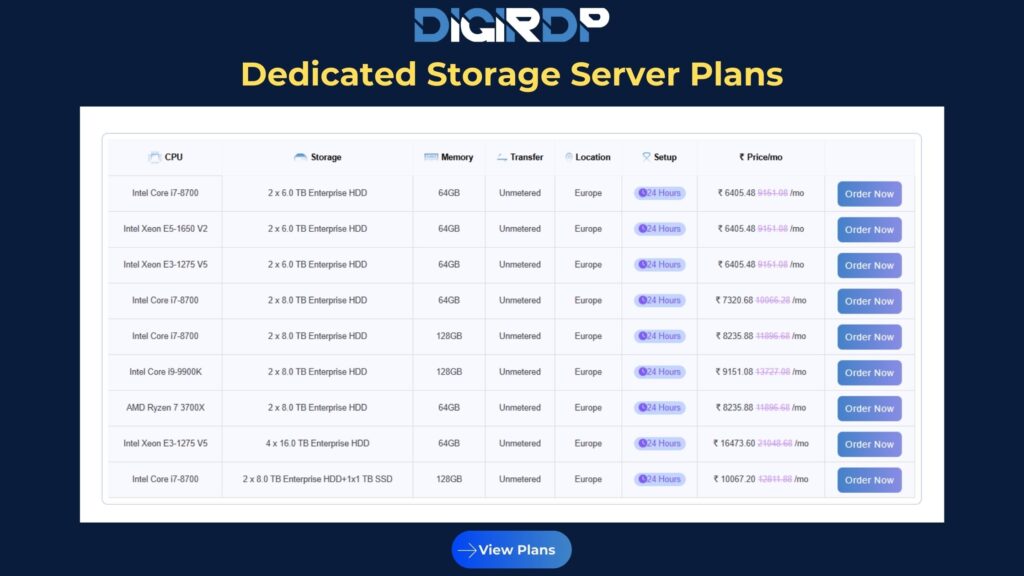
DigiRDP offers flexible dedicated storage server configurations designed to support a wide range of workloads, from basic backups to enterprise-level data infrastructure.
Ready to deploy your own server?
Full admin access, DDoS protection and instant setup — pick a plan sized to your workload.
Explore Dedicated Servers