



On this page
If you require stable U.S. access for trading, gaming, surveys, or system administration, a standard data centre RDP often fails to meet modern requirements. Shared IP pools, overused subnets, aggressive reputation scoring, and inconsistent routing introduce blocks, verification loops, and avoidable downtime—especially as platforms tighten enforcement in 2026.
Residential RDP USA has emerged as the new baseline because it aligns with how access is actually evaluated today. Instead of generic server IPs, it provides real American residential IPs, matched with compliant virtualization, realistic network fingerprints, and infrastructure engineered for predictable low-latency performance. This shift isn’t about convenience—it’s about meeting the technical and trust expectations now enforced by U.S.-based services.
As a server administrator working with current virtualisation stacks, IP reputation systems, and compliance-driven environments, I’ll break down how residential RDP works in 2026, why it has become essential rather than optional, and why DigiRDP has emerged as the preferred provider for users who need reliable, long-term American access instead of disposable setups.
What Is Residential RDP USA and Why It Matters in 2026
Residential RDP USA is a remote desktop hosted on real U.S. residential IP addresses provided by American ISPs, not datacenter networks. In 2026, this matters because most platforms actively detect and restrict datacenter IPs, causing blocks, verification issues, and account bans.
Residential IPs appear as normal household connections, making them far more trusted by U.S.-based websites, brokers, survey platforms, and gaming services. This results in higher acceptance rates, stable sessions, and fewer interruptions.
From a technical standpoint, modern residential RDPs run on enterprise hardware such as AMD Ryzen or EPYC processors, NVMe storage, and KVM or Hyper-V virtualization. This combination delivers low latency, consistent uptime, and reliable performance across the United States.For anyone needing secure and legitimate U.S. access in 2026, residential RDP is no longer optional—it is the standard solution.
For anyone needing secure and legitimate U.S. access in 2026, residential RDP is no longer optional—it is the standard solution.
Why DigiRDP Residential RDP USA Is Different
When evaluating any American RDP, I look at five technical pillars that separate disposable setups from infrastructure you can actually rely on. DigiRDP stands out because it performs consistently across all of them—not just one or two. Instead of optimizing for a single headline feature, its residential RDP offering is built as a complete U.S.-based environment where IP authenticity, geographic accuracy, session stability, performance, and detection-aware design work together as one system. This holistic approach is what turns an RDP from a short-term workaround into dependable infrastructure for serious, long-term use.
1. Real US Residential IP Allocation
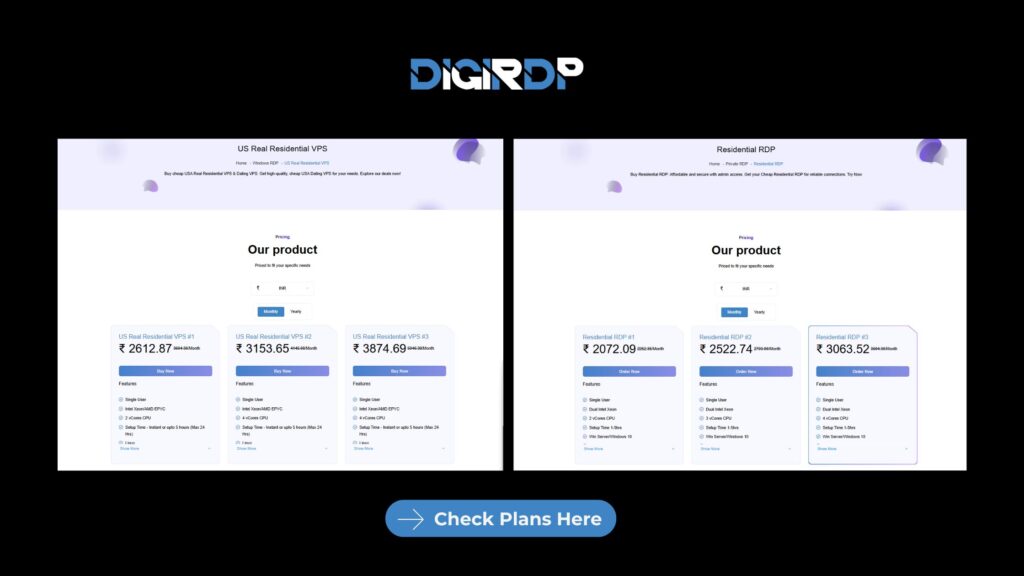
DigiRDP provides true residential IPs, not recycled VPS ranges. If you’re working with US-only platforms, this is non-negotiable.
👉 Check Plans Here:
2. Enterprise Hardware (2026 Standard)
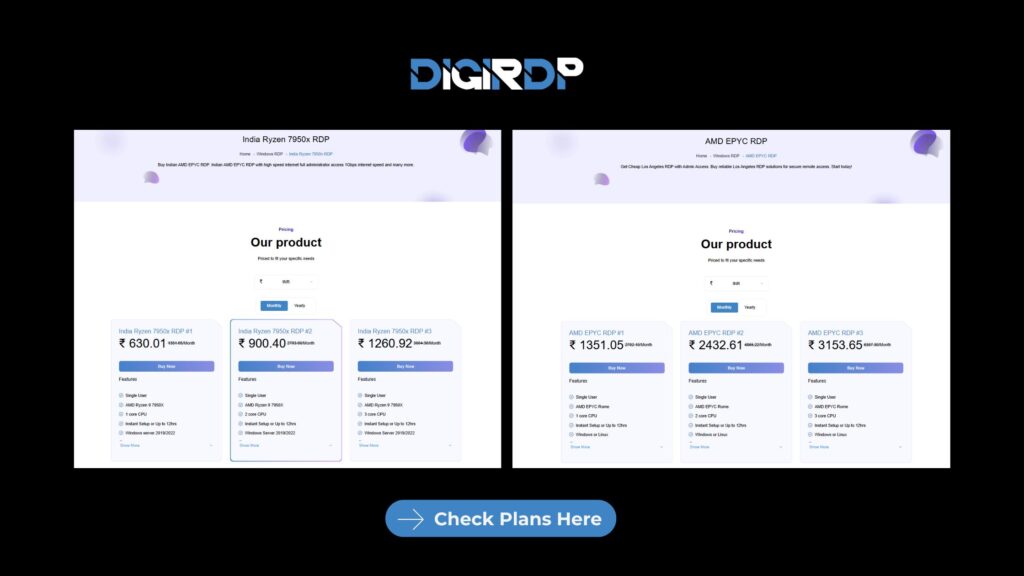
- No vague “high performance” claims—actual specs matter.
- CPU: AMD Ryzen 9 7950X / EPYC 7003 Series
- Storage: NVMe 4.0 SSD (Ultra-low I/O latency)
- RAM: DDR4/DDR5 ECC
- Virtualization: KVM & Hyper-V (isolated resources)
India Ryzen 7950x RDP. For high-power workloads or gaming, DigiRDP also offers Ryzen and EPYC nodes:
3. Network Performance & Latency
- Port Speed: 1Gbps standard (10Gbps on premium nodes)
- Routing: Optimized US backbone
- Latency: Sub-30ms within the US
- This is critical for Forex traders, gamers, and streaming workloads.
Who Should Use Residential RDP USA?
Forex Traders (MT4 / MT5)
Running MT4 or MT5 on a residential IP avoids broker-side restrictions and ensures uptime.
Benefits
- Always-on trading terminals
- Low latency to US brokers
- Reduced account flags
Survey & CPA Workers
Most survey platforms aggressively block datacenter IPs.
Residential RDP advantages:
- Higher acceptance rates
- Fewer rejections
- Stable session persistence
Gamers & Emulator Users
Yes, gaming over RDP works—if the hardware is right.
With Ryzen 7950X CPUs and NVMe storage, DigiRDP supports
- Android emulators
- Idle MMO farming
- Game automation tools
Admins & Power Users
Need full control?
DigiRDP offers Admin RDP access, ideal for developers and automation tasks:
Cheap vs Premium Residential RDP – What You’re Really Paying For
Budget seekers often ask if cheap RDPs are “good enough.”
👉 Affordable entry-level options are available:
But understand the trade-offs:
| Feature | Cheap RDP | DigiRDP Residential |
|---|---|---|
| IP Quality | Mixed | Clean residential |
| CPU Allocation | Oversold | Dedicated cores |
| Storage | SATA SSD | NVMe 4.0 |
| Support | Limited | 24/7 |
| Uptime | Unstable | 99.9% |
For business use, false economy costs more long-term.
Security & Compliance (Often Ignored, Always Critical)
From an infrastructure standpoint, residential RDP must be secure.
DigiRDP implements:
- Windows Defender hardened images
- Isolated KVM virtualization
- DDoS mitigation at edge
- Regular OS patching
Unlike cheap shared RDPs, residential nodes are not overcrowded, reducing lateral risk.
DigiRDP vs Generic Providers (2026 Comparison)
| Feature | DigiRDP | Generic RDP Seller |
| Residential IPs | ✅ Real US ISPs | ❌ Datacenter |
| Hardware Transparency | ✅ Full specs | ❌ Vague |
| Virtualization | KVM / Hyper-V | Unknown |
| Support | 24/7 Technical | Ticket-only |
| Scalability | Easy upgrades | Limited |
How to Choose the Right Residential RDP USA Plan
From an admin perspective, choose based on workload, not price.
- Surveys / CPA: Entry residential plan
- Forex / Trading: Mid-tier with higher uptime
- Gaming / Automation: Ryzen or EPYC nodes
- Admins / Devs: Admin RDP with isolated resources
Conclusion:
In 2026, choosing a reliable USA residential RDP with low latency is essential for users who require fast, stable, and location-authentic remote access. A well-optimized residential RDP setup ensures smoother performance for activities like remote work, automation, trading, and managing geo-restricted platforms. By focusing on strong hardware, optimized routing, and secure US residential IPs, users can experience minimal lag, better uptime, and fewer connection issues.
Brands like DigiRDP position themselves as providers aiming to deliver high-performance, low-latency USA residential RDP solutions with consistent speed, security, and reliability. Selecting a trusted provider with a solid network infrastructure helps ensure dependable connectivity and a more efficient remote-desktop experience. Overall, investing in a quality residential RDP service in 2026 can significantly improve productivity, stability, and long-term performance for professional users.
Ready to deploy your own server?
Full admin access, DDoS protection and instant setup — pick a plan sized to your workload.
Explore Windows RDP plans